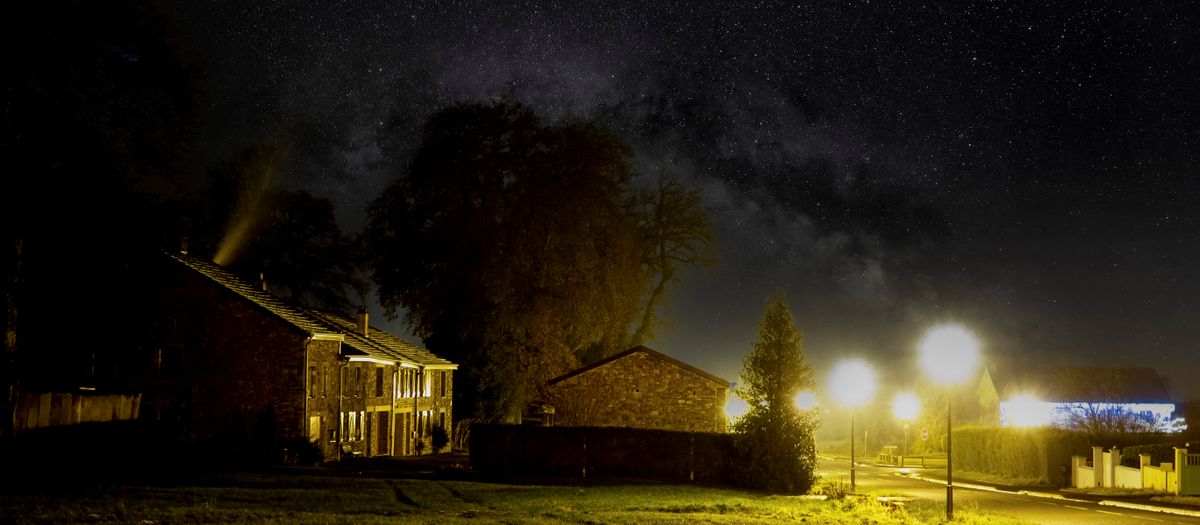
The most common thing beginners say to me, right after “I want to see Saturn,” is “but I live in the suburbs, so there’s no point.” I get it. You read about dark-sky parks and the Milky Way arching overhead, you look up from your own backyard and see maybe a dozen stars, and you assume the hobby is closed to you.
It isn’t. I want to walk through what you can genuinely see from a glowy backyard, because the honest answer is “a surprising amount,” and the disappointment that makes beginners quit usually comes from aiming at the wrong things, not from the sky glow itself.
A quick note on my own situation, so you can calibrate. I live just outside Prescott, Arizona. My skies are darker than a big city’s but they’re not pristine — there’s a glow over town to the south, my neighbor runs a porch light I quietly resent, and on a humid night the whole sky milks over. Plenty of my observing happens in conditions a suburban reader would recognize. So this isn’t a dark-sky purist talking down to you.
The Moon doesn’t care about light pollution
Start here, always. The Moon is bright enough that streetlights, sky glow, and your neighbor’s floodlight mean nothing to it. From the worst backyard in the worst suburb, the Moon through even a modest scope is genuinely stunning — craters with sharp shadows, mountain ranges, the ragged terminator line where lunar day meets lunar night.
A tip that took me years to learn: a full Moon is actually the worst time to look at it. It’s flat and glaring, with no shadows. Catch it a few days either side of full — a half Moon or a crescent — and the low sun angle throws long shadows that make craters leap out in 3D. The Moon is the one target where a city dweller has exactly the same view as I do, and it never gets old.
The planets punch through the glow
Here’s the thing most beginners don’t realize: the bright planets are points and small discs of intense light, and light pollution doesn’t wash them out the way it washes out faint, spread-out fuzzy objects. Planet observing from the suburbs is almost as good as from a dark site.
From my backyard, on a steady night, here’s what’s realistic in a typical beginner scope:
- Jupiter — a small cream-colored disc with two or three dark cloud bands across it, and its four big moons strung out like beads on either side. The moons move night to night; catch them in a different arrangement each time.
- Saturn — the showstopper. A pale gold ball with the rings clearly separated from the planet. Small, but unmistakable, and the first time you see it you’ll understand why I do this.
- Mars — honestly the most overhyped. Most of the time it’s a tiny orange dot. Near its close approaches every couple of years it grows into a small disc where you can tease out a darker marking or a polar cap on a good night. Manage your expectations and it’s a treat; expect a postcard and you’ll be let down.
- Venus — bright enough to see in twilight, and it shows phases like a tiny moon, from a fat crescent to a small gibbous disc. No surface detail, but the phase itself is a genuine thrill.
Steadiness of the air (“seeing,” astronomers call it) matters far more than darkness for planets. A turbulent night makes Jupiter boil and shimmer no matter how dark your sky.
Double stars: the unsung backyard target
This is the category nobody tells beginners about, and it’s tailor-made for light-polluted skies. Double stars are two stars that sit close together — sometimes a true orbiting pair, sometimes a chance line-up. Splitting them into two clean points is a real skill and a real pleasure, and because they’re bright pinpoints, sky glow barely touches them.
Some are color-contrast pairs that look like little jewels. Albireo, in the constellation Cygnus, is the famous one — a gold star and a blue star side by side. From my mediocre-sky nights it’s as pretty as anything in the catalog. There are hundreds of these, and a backyard is a perfectly good place to hunt them.
Deep-sky: the brighter half is still open to you
“Deep-sky objects” (DSOs) means everything beyond our solar system — star clusters, nebulae, galaxies. This is the category light pollution hits hardest, because these objects are faint and spread out, exactly the kind of thing sky glow drowns. But “hits hardest” isn’t “wipes out.” The brighter ones still come through.
From a suburban backyard with a decent scope you can realistically expect:
- Open star clusters — loose sparkly groups like the Pleiades or the Beehive. These survive light pollution well and look great.
- Globular clusters — tight balls of tens of thousands of stars. The brightest, like M13 in Hercules, show up even from town as a fuzzy ball that resolves into grains at the edges in a bigger scope.
- The brightest nebulae — the Orion Nebula (M42) is the standout. Even from a glowy yard it’s a visible smudge of gray-green glow with stars buried in it. It won’t look like the photos (nothing does, by eye), but it’s clearly there.
- A few bright galaxies — Andromeda (M31) shows as an elongated faint glow, the Whirlpool and others as dim smudges on your better nights.
What you mostly won’t get from the suburbs is the dim galaxies, the faint nebulae, and the sweep of the Milky Way overhead. Those need real darkness. Knowing which side of that line each object falls on is half the battle, and it’s why beginners who chase faint galaxies from town give up — they’re trying to see things the sky won’t give them, and blaming their scope.
The honest summary
From a light-polluted backyard, plan your nights around bright, compact, high-contrast targets: the Moon, the planets, double stars, and the brightest clusters and nebulae. That’s a target list that’ll keep you busy for years, and not one item on it requires you to drive anywhere.
When you’re ready to push further — chase the faint stuff, learn what a given aperture realistically pulls in, and figure out what’s worth a drive to darker skies — I keep a running, honest breakdown over in what you can see with a telescope. It matches objects to apertures so you can aim at things your scope and your sky will actually deliver.
The dark-sky trips are wonderful and worth doing. But don’t let “I live in the suburbs” be the reason you never start. Most of the best beginner sights are sitting right over your own roof, waiting.