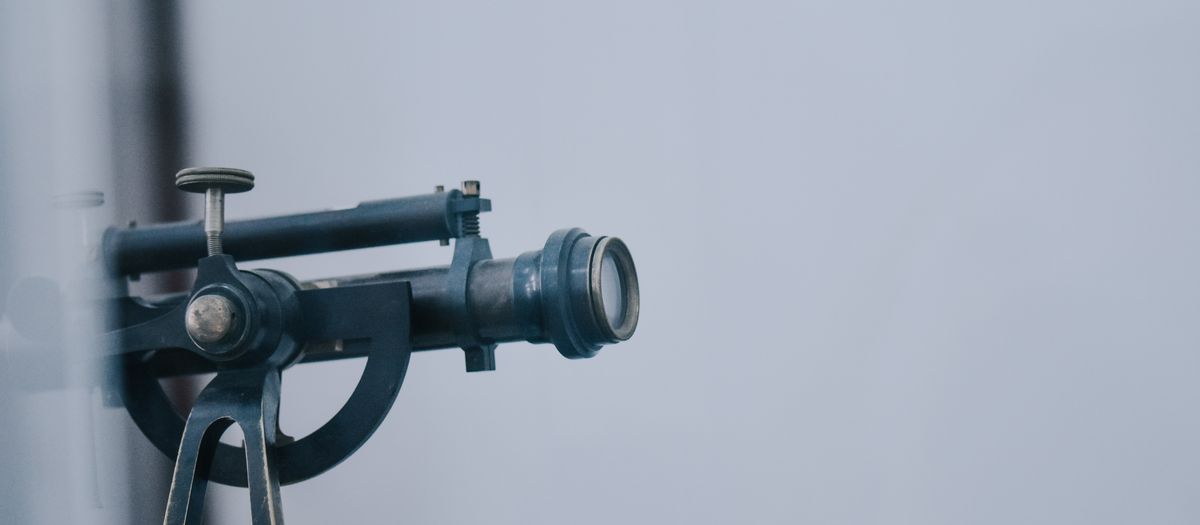
I want to tell you about the worst purchase of my childhood. Not because it makes a fun story — it doesn’t, really — but because the same mistake is still being sold today, in nearly the same box, and I’d like you to walk right past it.
When I was about eleven, I saved up for months for a telescope. Birthday money, lawn-mowing money, the change jar. I had a picture in my head of Saturn floating in the eyepiece. The box I finally bought had a glossy photo of a galaxy on the front and, in letters bigger than the brand name, the number that sold it to me: 600x.
Six hundred power. I thought I’d be able to read license plates on the Moon.
What actually happened
The first clear night, I dragged it out to the back patio. The tripod was aluminum and thin, the kind that flexes if you breathe near it. I pointed the tube at the Moon — the easiest target in the whole sky, a thing you genuinely cannot miss — and put in the eyepiece marked with the highest power, because of course I did. That’s what 600x was for.
The Moon was a fuzzy, shaking blob. Every time I touched the focus knob, the whole image jumped halfway across the field of view and took five seconds to settle. When it did settle, it was dim and soft, like looking through a smeared window. I swapped to a lower-power eyepiece and it got a little better — a little — but by then I’d decided the problem was me.
I tried for planets and never found one. The little finder scope on the side was bent and pointed somewhere other than the main tube, so even aiming was a guessing game. After a few frustrating nights I put the whole thing back in its box, slid it into a closet, and more or less concluded that backyard astronomy was a thing other people could do and I couldn’t.
That scope sat in that closet for the better part of fifteen years.
What was actually wrong
Here’s the thing that took me a long time to understand: there was nothing wrong with me. There was a lot wrong with the scope, and almost all of it came down to two numbers nobody had taught me to read.
The aperture was tiny. Aperture is the width of the main lens or mirror — the opening that lets light in. Mine was about 50mm, barely two inches. That’s how much sky-light the scope could actually gather, and it sets the ceiling on everything: how bright the view is, how much fine detail you can pull out. A two-inch lens is a small bucket. It doesn’t matter how you tune it; it can only catch so much rain.
The magnification was a lie. That “600x” on the box wasn’t a feature, it was a marketing trick. There’s a rough physical limit to useful magnification — about twice the aperture in millimeters. My 50mm scope topped out around 100x of usable power. Past that, you’re just blowing up a blurry image bigger; you don’t see more, you see less, dimmer and mushier. The 600x eyepiece that came in the box was unusable on the scope it came with. They printed the biggest number they could and hoped a kid would buy it.
And the mount was junk. A wobbly tripod ruins more first nights than bad optics do — I’d put money on that. Even if the optics had been decent, an image that shakes for five seconds after every touch is an image you can’t enjoy.
So I had a tiny bucket, a fake number, and a tripod made of noodles. No wonder Saturn never showed up.
The night that brought me back
I came back to all this in my forties, and by accident. A neighbor mentioned the local astronomy club ran public nights, and I went mostly to be polite. Somebody had set up an 8-inch Dobsonian — a big, simple tube sitting on a plain wooden base that rocks up and down and side to side. No tripod, no electronics, no 600x printed anywhere.
The guy running it swung it toward Saturn, told me to look, and stepped back.
I actually laughed out loud. There it was — a tiny, sharp, pale-gold ball with the rings standing clean off to either side, looking exactly like the cartoon of a planet, except it was real light arriving in my eye in real time. No screen. No photo. Just photons that left Saturn over an hour earlier landing on my retina. I’d waited thirty years for that and a cheap box had stolen it from me as a kid.
The difference wasn’t magic. That Dob had about an 8-inch mirror — roughly sixteen times the light-gathering area of my childhood scope — sitting on a base so steady you could nudge it and the image would settle instantly. Same sky. Same Saturn. Completely different instrument.
What I’d buy instead
If I could hand my eleven-year-old self one piece of advice, it would be five words: buy aperture, ignore the magnification.
Concretely, here’s what I steer beginners toward now, and what I wish I’d had:
- A 6- or 8-inch Dobsonian reflector. Big mirror, simple steady base, most of your money going into glass instead of gadgets. It shows the Moon’s craters in crisp relief, Jupiter’s cloud bands and four moons, Saturn’s rings, and — from a darker spot — star clusters and the brighter nebulae. It’s the scope that made me laugh out loud.
- A scope judged by inches or millimeters, never by an “x” number. If the most prominent number on the box is a magnification, that box is built to fool you. Turn it over and find the aperture.
- A mount that holds still. Whether it’s a Dobsonian base or a real tripod, steadiness matters as much as the optics. The view you can’t keep in the eyepiece is a view you won’t enjoy.
If you want the full rundown of which scopes clear that bar and which to skip, I put it all in the guide to the best telescope for beginners. It’s the page I’d have wanted in my hands at the cash register, before I ever picked up that 600x box.
The part that still bothers me
What gets me, looking back, isn’t the wasted money. It’s the wasted years — the decade and a half that scope sat in the closet while I quietly believed the night sky wasn’t for me. That belief is the real damage these cheap scopes do. They don’t just fail to show you Saturn; they convince you the failure is yours.
So if you’ve got a dusty department-store scope and a story like mine, I’d gently suggest the scope lied to you. The sky is still up there. It’s genuinely worth a real first light — and a real first telescope gets you one.