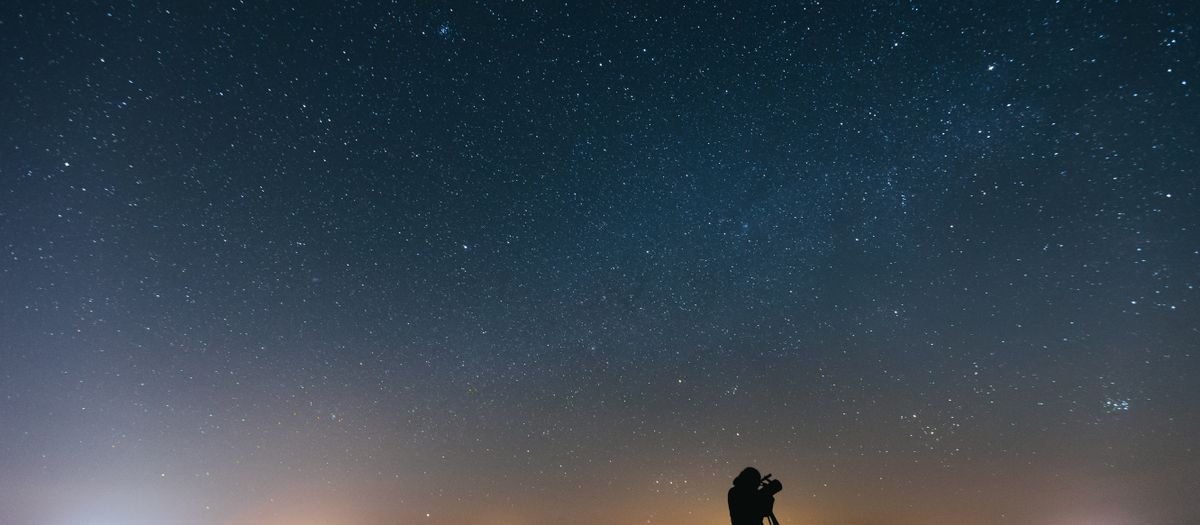
You’ve got the scope. Tonight’s clear. You’re a little nervous it won’t work or you’ll feel stupid. I’ve stood next to dozens of beginners at their very first eyepiece, and I can tell you exactly how the good first nights go — so let’s walk through one, start to finish, the way I’d talk you through it if I were standing in your backyard.
The whole trick to a happy first night is doing a few small things before it gets dark and aiming at the easy targets first. Beginners who fumble in the dark trying to find a galaxy give up. Beginners who set up calmly and start with the Moon end up hooked.
Before sunset: set up while you can still see
Carry everything out and set it up in daylight, or at least in dusk. Fumbling with parts in the dark, by feel, while you get cold and frustrated, is how first nights go wrong. Get the scope assembled, the eyepieces laid out where you can find them, and a chair nearby.
Two things people skip, and shouldn’t:
Align the finder. Every scope has a little finder — a small sight or a red-dot pointer — bolted to the side, and it’s almost never aimed at the same spot as the main tube out of the box. In daylight, point the main scope at something distant and obvious (a power pole, a chimney, the top of a far hill — never anything near the Sun). Center it in a low-power eyepiece, then adjust the finder’s screws until its crosshair or red dot sits on the same thing. Now your finder actually finds. Skip this and you’ll spend the whole night hunting blind.
Let the scope cool down. A telescope brought out from a warm house has warm air and warm glass inside, and that warmth makes the image shimmer and soften until it settles to outdoor temperature. A small refractor cools in fifteen or twenty minutes; a big reflector can take an hour. So carry it out early and let it sit while you wait for dark. This one habit alone will sharpen your views more than most accessory upgrades.
As it gets dark: let your eyes adjust, and grab a red light
Give your eyes time. Real night vision takes twenty to thirty minutes to build, and one glance at a white phone screen wipes it out in an instant. Get yourself a red flashlight — red light lets you read a star chart and find your eyepieces without destroying your dark adaptation. A regular white flashlight or your phone’s screen will blind you to the faint stuff for another half hour every time you use it.
While your eyes adjust, just look up. Pick out the brightest things. Notice that one or two “stars” shine with a steady, non-twinkling light — those are usually planets, and they’re your evening’s best targets.
Target one: the Moon (if it’s up)
If the Moon is in the sky, start there. It’s the single most forgiving, most rewarding first target in astronomy. It’s big, it’s bright, you literally cannot miss it, and it looks fantastic.
Put in your lowest-power eyepiece first — that’s the one with the biggest number printed on it, like 25mm or 32mm. Lower power gives a wider, brighter, more forgiving view that’s far easier to aim and focus. Get the Moon centered using your freshly-aligned finder, then look through the main eyepiece and slowly turn the focus knob until the craters snap sharp.
Take your time here. Run your eye along the terminator — the line dividing the lit and dark halves — where the shadows are longest and the craters look three-dimensional. Once you’re enjoying it, then try a higher-power eyepiece (smaller number) to zoom in on a single crater. If the view gets dim and mushy, you’ve gone too far; back off. This is also where you learn the feel of focusing and nudging the scope to track an object as Earth’s rotation slowly carries it out of view.
Target two: Saturn (the one you came for)
Find the steady, non-twinkling “star” you spotted earlier and check a free sky app to confirm which planet it is. If Saturn’s up, that’s your moment.
Aim the finder at it, look through your low-power eyepiece, and focus. At low power Saturn looks like a tiny, slightly oval bright bead — that’s the rings, not yet resolved. Now step up to a medium-power eyepiece and refocus. Somewhere in there, it happens: the bead resolves into a small, sharp, pale-gold ball with the rings standing clean off to either side.
I’ve watched this moment land on dozens of faces and it’s the same every time — a pause, then a laugh or a quiet “no way.” It looks exactly like the cartoon of a planet, except it’s real, and small, and trembling slightly in the air currents, and yours. That’s first light. That’s the whole reason.
If the air is turbulent, Saturn will boil and shimmer. Be patient and watch for the brief still moments when the atmosphere settles and the image sharpens — they come and go second by second, and the detail in those windows is the real view.
When it doesn’t go smoothly (because sometimes it won’t)
A few honest contingencies:
- Can’t find anything? Your finder probably drifted or wasn’t aligned. Re-aim it on the Moon or a bright planet, the two easiest things to center on.
- Everything’s a blur you can’t focus? The scope may not be cooled yet, or you may have jumped straight to high power. Drop to your lowest-power eyepiece and give it time.
- The image shakes constantly? Your mount or tripod is the culprit. Make sure it’s on firm ground and not splayed on a soft lawn, and resist over-tightening. A wobbly mount ruins more first nights than bad optics do — if yours is the weak link, that’s worth fixing before anything else.
- Cloudy after all? Welcome to the hobby. Clear nights are a resource you learn to pounce on. Pack up, no harm done.
What to do with that first night
Don’t try to see everything. A good first night is the Moon, one planet, and the feeling of working the scope a little more smoothly by the end than at the start. That’s a win. The deep-sky stuff, the star-hopping, the fainter targets — those come later, once the basics feel like muscle memory.
If you’re still at the choosing stage and want a scope that makes a night like this easy instead of a fight, that’s exactly what I weigh up in the guide to the best telescope for beginners — the scopes that get you to Saturn on night one, and the ones that get put back in the closet.
Set up early. Start with the Moon. Be patient with Saturn. That’s a great first night, and it’s well within reach the very first time out.